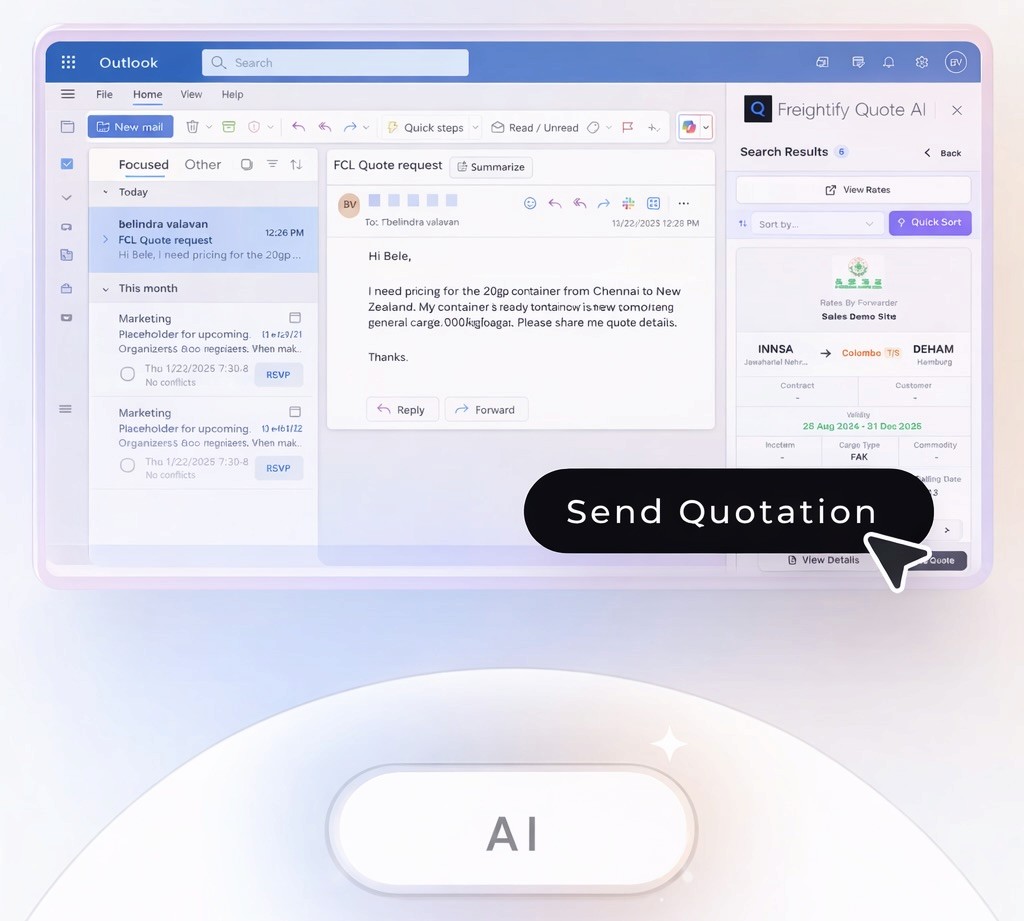
Eliminate margin leakage in freight forwarding. Understand the Tax on Fragmentation, the four strategic pillars, and how AI-first rate governance transforms decisions.

Team Freightify
For too long, we in freight forwarding have accepted a simple, costly lie: that growth must come at the cost of complexity. This acceptance has created a structural burden, a hidden financial cost we call the Tax on Fragmentation.
The CXO's Urgent Mandate: You've automated your day-to-day transactions, yet 91% of forwarders still face acute margin pressure [1]. This isn't just market risk; it's a systemic failure. We provide the 10 criteria required to future-proof your rate governance and eliminate this tax.
The Executive Blind Spot: The Cost of Process Complexity
Your core operational systems are brilliant at keeping records, but they were never designed to be the Authority for Margin Governance across decentralised teams. Over-reliance on your TMS for transaction-level rate control creates a systemic failure that undermines your entire procurement strategy.
Large enterprises lose an average of $12.9 million annually [2] due to data errors and process management.
However, this cost is being intensified and rendered unmanageable by two compounding market risks:
Talent Drain: where rising senior turnover (up by 33% [4]) removes the final human check on your fragmented data
Volatility Exposure: When there are incidents like the SCFI surge by 149% [3], your organisation needs instantaneous alignment. Fragmentation prevents this, turning market opportunity into execution risk.
The Problem in Practice Hindering Teams:
Every freight forwarding CXO has seen the scenario: an account manager promises a rate to a client based on a quick check on a carrier website or outdated or otherwise insufficiently backed information, possibly without appropriate sales margin, only to find Operations, Procurement or Finance disagree on the final surcharge breakdown and actual cost to operate the shipment.
This specific conflict, where the actual cost meets the promised price, is the direct result of fragmented cost data living in separate, non-up-to-date systems and documents (e.g. Procurement platforms, locally stored rate sheets, Operations TMS, Sales quotes, Customer portal, CRM, Finance ERP). This internal failure to synchronize rate components is the Tax on Fragmentation in action, directly contributing to the $12.9 million annual cost of poor data quality [2] through lost margin, wasted efforts, or avoidable client friction.
The AI-Forward Mandate: Shifting to Rate Intelligence
The path forward requires adopting a measured, intelligence-first approach to move from managing data in silos to leveraging data integration & up-to-dateness for the benefit of well-orchestrated decisions.
The Orchestrated Advantage
Risk Profile: Fragmented Rate Management | Value Profile: AI-Enabled & Integrated Automation-First RMS |
|---|---|
Rates siloed, requiring manual validation. | Rate-Automation into the Integrated Rate Engine allows accurate, instantaneous global quoting. |
Procurement/Operations/Sales as Data Administrators. | Procurement/Operations/Sales as Process Controllers. |
Decisions driven by intuition and spreadsheets. | Decisions informed by accurate real-time rate data (contracts, tariffs, spot) supplemented by selling rules, benchmarks and buy-side change alerts. |
Our Point of View on How to Future-Proof Rate Governance:
We believe the future belongs to those providers who will be able to offer solutions that are strong in most or all of the following 10 areas across 4 primary pillars:
The Foundation of Trust and Scale (Data & Security)
This area ensures the system is reliable, secure, and has the data integrity needed for strategic decision-making.
System of Record: Serve as the definitive, reliable System of Record for sustainable business operations, ensuring data integrity is never compromised.
Structured Master Data: Provide a wealth of well-managed master data, moving beyond an "empty shell" to offer immediate, actionable context.
Comprehensive Technology & Security: Offer comprehensive business capabilities and depth in technology, structured data storage, and advanced security protocols.
The Automation Engine (Speed & Intelligence)
This area directly addresses the erosion of margin caused by manual effort, data latency, and market lag.
Holistic Automation Suite: Deliver end-to-end automation of rate documents, powered by a comprehensive suite that combines: Agentic AI, Classic Automation (code-based), intelligent Workflow Management, and Human in the loop support for verification.
Integrated Procure-to-Sales Flow: Enable a singular, integrated Rate and Quotation Management flow to manage the procure-to-sales process holistically, eliminating data fragmentation.
Instant Market Comparison: Enable easy comparison of spot & contract rates from a long list of online sources with stored tariff rates, ensuring real-time competitive pricing.
Seamless Enterprise Adoption (Connectivity & Experience)
This area focuses on reducing friction during migration and maximizing user adoption.
Out-of-the-Box Integration: Support seamless process integration with other ecosystem components (e.g., leading TMS solutions) out-of-the-box, ensuring control and transparency across the enterprise.
Superior User Experience: Be intuitive and easy to operate, providing a superior UI and user experience designed to foster instant adoption.
Low-Barrier Migration: Offer attractive and relevant business features designed to make adoption and migration from legacy solutions simple and low-barrier.
The Partnership Pledge (Commitment)
This is a promise about the vendor's philosophy and evolution.
Dynamic Product Evolution (The Right Spirit): Maintain a continuous, pro-active, and dynamic evolution of products & services, leveraging the latest technology and guided by customer-centric product management and professional support processes.
Freightify’s Point of View: Partnership through Precision
At Freightify, we fundamentally view our role as that of an empowering partner, providing the precise technological levers required to strategically manage today's complexity.
We are fully committed to helping you preserve and extend your competitive edge. We don't aim to replace your systems or diminish your high-value people; we aim to integrate and elevate their collective capability.
What Price Are You Paying?
The question is no longer "Can we afford new technology?" but "Can we afford to continue paying the Tax on Fragmentation?"
Download our complimentary Freight Procurement Decision Audit Checklist to quantify your margin leakage and secure your executive mandate today.
Audit your readiness. Protect your margins.
Get the Free Freight Procurement Decision Audit Checklist and identify your highest-impact next steps.
Spot hidden margin leakage
Score your data & rate governance
Discover your next action plan
References
[1] Ti Insights. (2024). Global Freight Forwarding 2024 Report (Referencing survey data that 91.1% of forwarders are experiencing increased pressure on margins).
[2] Gartner: "The average annual cost of poor data quality to organizations was $12.9 million." (This figure is typically sourced from Gartner research published around 2020-2021)
[3] Asian Business Review/UNCTAD data. (2024). What pushed spot container freight rates up in 2024 (Referencing the 149% increase in the Shanghai Containerized Freight Index in 2024).
[4] McKinsey & Company. (2024). AI can transform workforce planning for travel and logistics companies (Referencing data that turnover of logistics employees is up by 33% compared with before the COVID-19 pandemic)
FAQs:
1. What is the Tax on Fragmentation in freight forwarding?
It is the hidden financial loss created by siloed rate data, outdated spreadsheets, and disconnected systems. This fragmentation leads to incorrect pricing, margin leakage, execution delays, and customer friction.
2. Why do forwarders still face margin pressure despite digitalization?
Because most digitalization focuses on transactions (via TMS/RMS), not the intelligence layer that governs rates, pricing, and profitability.
3. How much do data errors cost freight forwarding companies?
According to Gartner, companies lose $12.9 million annually on average due to data errors, misaligned processes, and poor rate governance.
4. What triggers margin leakage in freight procurement?
Outdated rate files
Inconsistent surcharge structures
Manual validations
Regional silos
Misalignment between Procurement, Pricing, Sales & Ops
High senior staff turnover
5. How does AI improve rate governance?
AI automates extraction, normalizes rate data, compares markets in real time, and enables orchestrated decisions across the procure-to-sell cycle.
6. What makes a modern Rate Management System “automation-first”?
It integrates AI, workflow automation, and human-in-loop verification into one continuous flow—from procurement to pricing to quoting.
7. Why is TMS not enough for rate governance?
TMS platforms are built for execution and record-keeping, not for real-time margin governance, rate comparison, or volatile market responsiveness.
8. What pillars should CXOs evaluate when choosing a next-gen RMS?
Data & security
Automation intelligence
Enterprise connectivity
Vendor commitment and product evolution
9. How can forwarders future-proof their freight procurement decisions?
By consolidating rate intelligence, eliminating fragmentation, adopting AI-enabled automation, and ensuring a unified rate governance model.
10. How can Freightify help?
Freightify delivers an integrated, AI-enabled RMS that centralizes rate intelligence, orchestrates procure-to-sell workflows, and removes the Tax on Fragmentation permanently.
Frequently Asked Questions
Q: What is data-driven decision-making in freight forwarding?
It’s the process of using centralized, structured data and AI insights to drive procurement, pricing, and quoting decisions across global teams.
Q: Why is it difficult for freight forwarders to become data-driven?
Because most use legacy TMS systems and Excel workarounds that trap information in silos, making collaboration and transparency difficult.
Q: What is decision intelligence in logistics?
Decision intelligence connects data, people, and AI systems to continuously learn from transactions—transforming experience into scalable foresight.
Q: How does AI improve freight pricing and procurement?
AI learns from historical contracts, quotes, and bookings to suggest optimal pricing, detect anomalies, and improve margin consistency.
Stay updated with Freightify
Subscribe to our blog for the latest updates and insights delivered to your inbox.
Suggested Stories
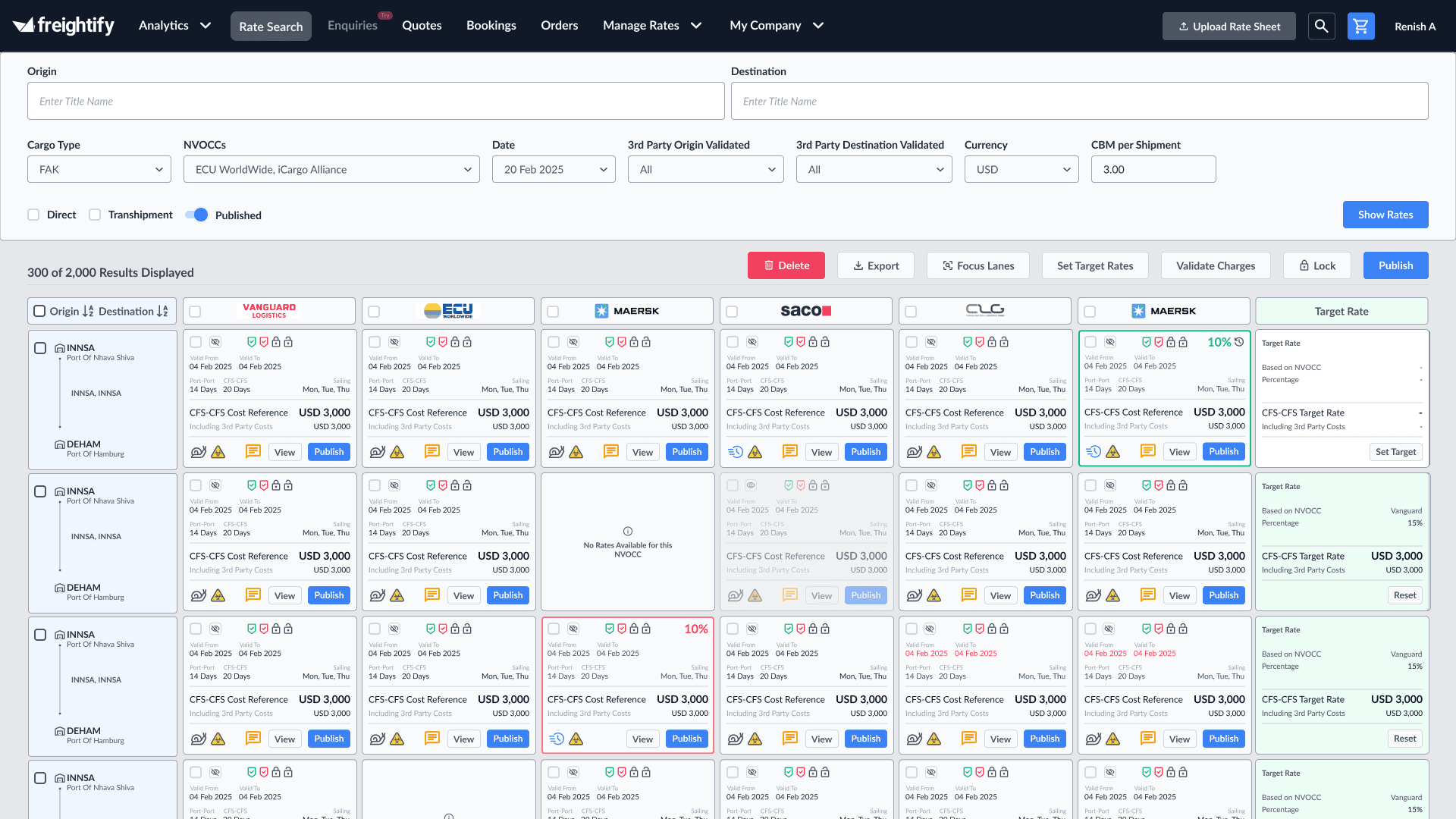
Your LCL Operation Has a Revenue Leak. Most Forwarders Never Find It.
Freight forwarders in the US and Europe lose LCL quotes daily — not from bad rates, but broken pricing workflows. See how the right LCL pricing software fixes this.
Wisor vs Freightify: Which Rate Management Platform Should You Choose? [2026]
Data-driven comparison based on 88 reviews. Implementation speed, multi-office capabilities, accuracy guarantees. 5-minute read.