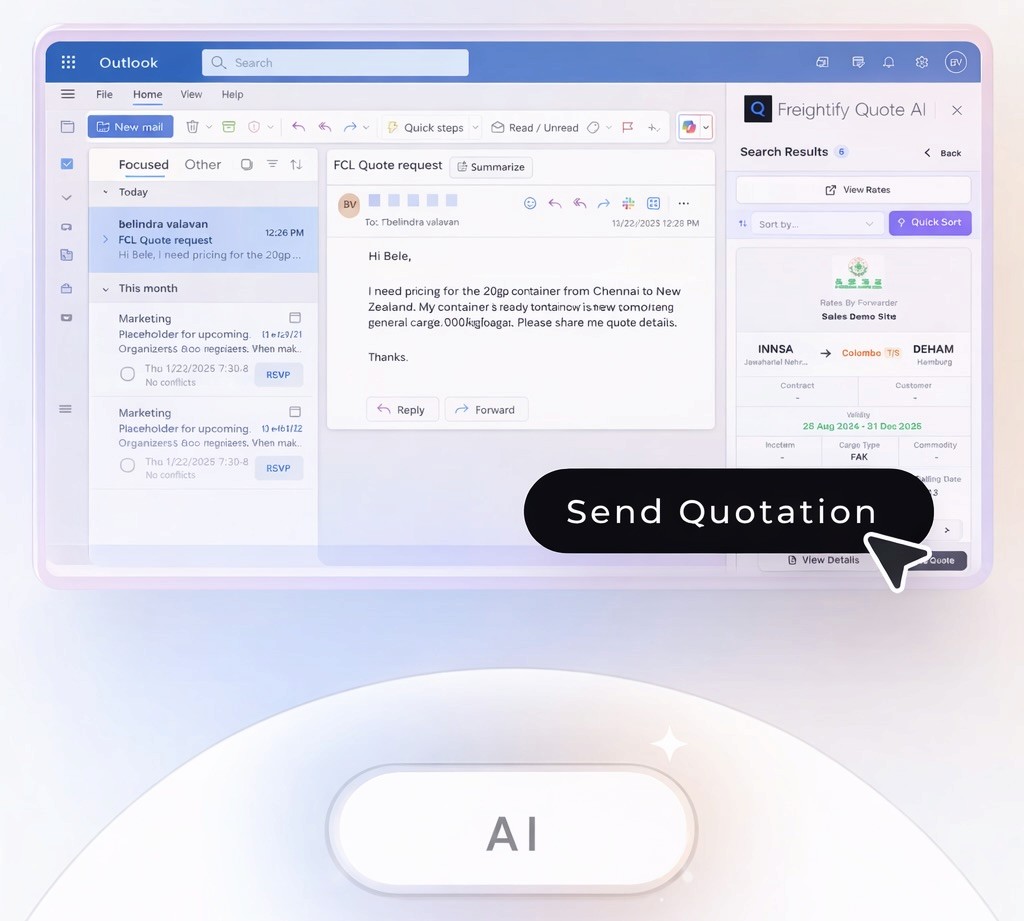
Freight forwarders in the US and Europe lose LCL quotes daily — not from bad rates, but broken pricing workflows. See how the right LCL pricing software fixes this.

Team Freightify
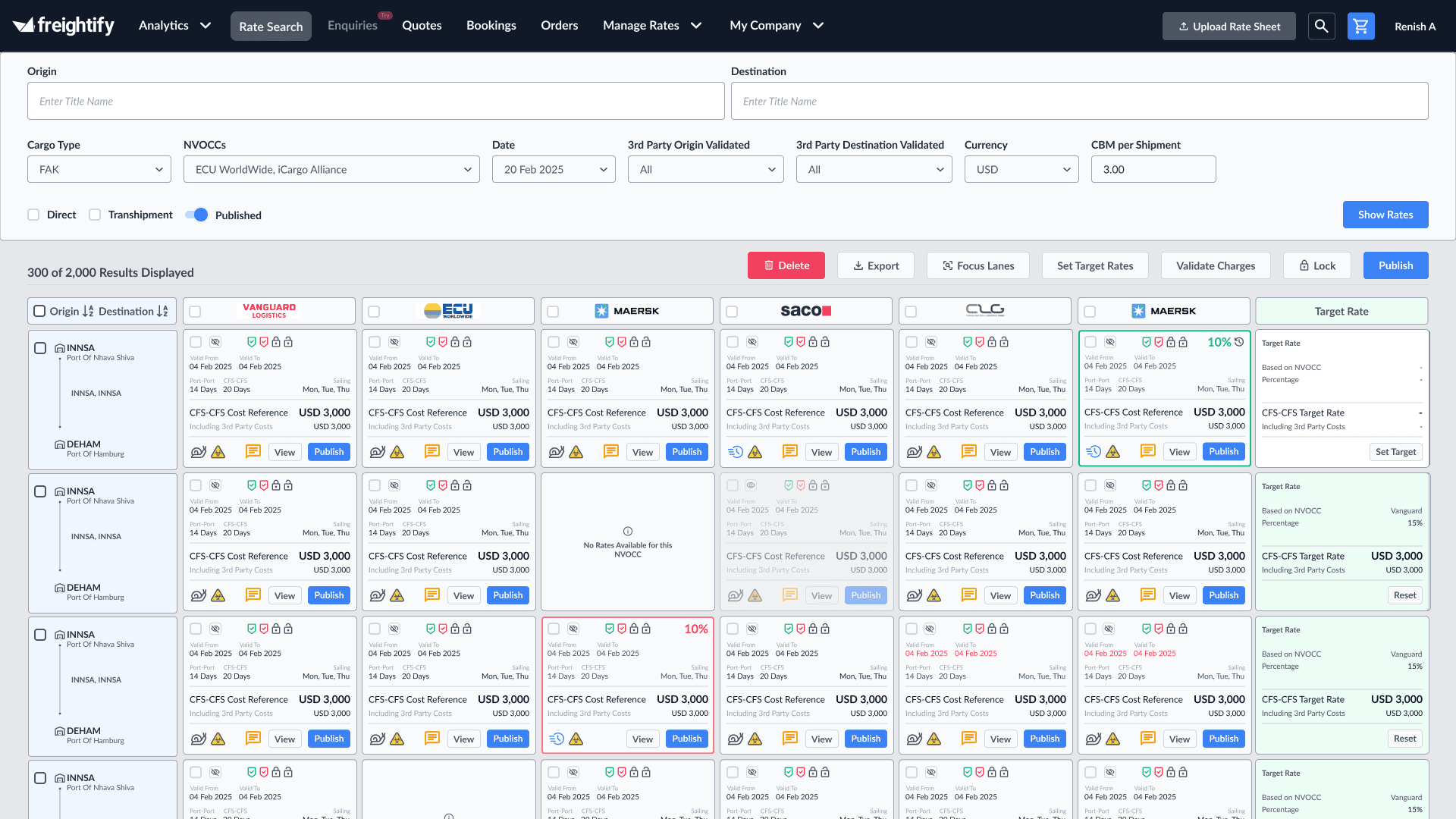
LCL Pricing Matrix
The leak is not in your rates.
It is in the workflow between procurement and sales.
You already know your LCL win rate could be better. What you may not know is that the reason isn't your rates, it's what happens to them between procurement and the customer.
In most freight forwarding operations, mid-market and enterprise alike, the rate your team negotiates with an NVOCC and the rate your sales rep quotes to a customer are separated by a chain of manual steps that nobody owns, nobody measures, and nobody fixes until a deal is visibly lost.
By then, it's already too late. The customer booked with a competitor. Not because that competitor had a better rate. Because they had a faster answer.
Speed of response is now a more reliable predictor of LCL win rate than price. Your pricing infrastructure determines your speed. And most forwarders have not looked at their pricing infrastructure in years.
Three business outcomes within your direct control
If you lead an LCL operation, these three outcomes are being shaped by your pricing workflow right now. Most operations are leaving all three on the table simultaneously.
Win rate: Quotes responded to within the hour close at significantly higher rates than those taking four hours or more. The gap is not margin. It is infrastructure.
Margin protection: When sales quotes from stale or unvalidated rates, the error surfaces in the invoice rather than the quote. By then the margin is gone and the relationship is already under pressure.
Scalability: Growing LCL volume without fixing the pricing workflow means growing the chaos proportionally. More NVOCCs, more formats, more manual steps, more errors, and a team that cannot keep up.
None of these are determined by what you negotiate with your NVOCCs. All three are determined by what happens inside your operation after the negotiation ends.
The same breakdown, two markets
Call it a groupage tariff in Europe. Call it a consolidation rate sheet in the US. The terminology differs by port and by continent, but the structural breakdown is identical.
Market | Local term | The specific pressure |
|---|---|---|
Europe | Groupage tariff | CFS surcharges differ meaningfully between Hamburg, Rotterdam, Antwerp, and Felixstowe. CAF moves with exchange rates. A tariff accurate on Monday may not be accurate by Friday, and there is no system in most operations that flags the difference before a quote goes wrong. |
US | Consolidation rate sheet | Tariff volatility has compressed validity windows on trans-Pacific consolidation lanes to sometimes under two weeks. Rate sheets valid at upload are not necessarily valid at quote. The margin between those two moments is invisible until a customer dispute makes it visible. |
In both markets, the failure point is the same. There is no structured system connecting the procurement team that owns the rates to the sales team that quotes from them. The handoff runs on email, shared drives, and institutional memory. All three break under volume. All three break under speed.
What the leak actually looks like
This is not a vague operational inefficiency. It is a specific, traceable sequence of breakdowns that occurs in every LCL operation running without dedicated LCL pricing software.
Where it breaks | What it costs the business |
|---|---|
Each NVOCC sends rates in a different format. Someone reformats manually before the rate can be used. | Hours of pricing team capacity consumed weekly on zero-value work. |
No single view to compare multiple NVOCCs on one lane. Comparison is built manually in a separate tab. | Slower procurement decisions. Suboptimal carrier selection. Higher cost basis passed on unnecessarily. |
Procurement target rates live in a document that is disconnected from the rate search workflow. | Sales quotes without knowing whether the margin is inside or outside target. Invisible margin give-away. |
Rate validity tracked manually. Expired rates circulate until someone catches them. | Invoice disputes. Margin given back after the fact. Customer relationships damaged at the worst possible moment. |
Sales calls pricing for a rate. Pricing is unavailable. The customer follows up twice and gives up. | Customer books with the competitor who responded first. The deal is gone before anyone realises what happened. |
The last row is the one that shows up as a lost deal. The four rows above it are why it happened. Fix only the last row, push the team to respond faster, and you have addressed the symptom. Fix all five and you have addressed the operation.
LCL Pricing Matrix
The leak is not in your rates.
It is in the workflow between procurement and sales.
What a fixed workflow looks like
The answer is not a better spreadsheet. It is a single system in which procurement and sales operate on the same validated data, in real time, with no manual handoff that can break under pressure.
Procurement uploads NVOCC rates once, in a standardised format regardless of how the carrier sent them. Every rate appears in a structured matrix with lanes as rows and NVOCCs as columns, with validity dates, charge breakdowns, and clear indicators for lowest, highest, fastest, and slowest options. Procurement sets target rates inside the same system. They validate, lock, and publish. From that moment, sales searches and quotes directly, any lane, any cargo type, any NVOCC, without calling anyone, without waiting, without the risk of quoting something that expired last Thursday.
The result is not marginal. Quote turnaround compresses from hours to minutes. Margin leakage from stale rates structurally disappears. The pricing team stops fielding calls for rates that should already be self-serve, and starts focusing on the work that actually requires their expertise: negotiating better rates, not managing broken workflows.
The decision in front of you
Every week your LCL pricing operation runs without this infrastructure is a week of quotes responded to too slowly, margins quoted inaccurately, and pricing team capacity spent on manual work that software should handle.
This is the problem Freightify's LCL Pricing Matrix was built to solve. Cocreated along with one of the top 3 Freight Forwarders, it is a dedicated module inside the Freightify Rate Management System that connects NVOCC procurement, rate validation, and sales quoting into a single structured workflow. It runs for European groupage operations and US consolidation operations equally. It is used by mid-market forwarders who need to punch above their weight on speed, and by enterprise operations that need consistency across teams, branches, and hundreds of CFS lane pairs.
LCL Pricing Matrix
The leak is not in your rates.
It is in the workflow between procurement and sales.
Frequently asked questions
What is LCL pricing software?
LCL pricing software is a dedicated platform that helps freight forwarders manage, compare, and publish less-than-container-load rates from multiple NVOCCs in a single structured workflow. It replaces manual spreadsheet-based rate management with an automated system that connects procurement, pricing, and sales teams so quotes go out faster and more accurately.
Why do freight forwarders lose LCL quotes to competitors?
Most LCL quotes are lost not because of rate differences but because of response time. When procurement rates are managed across multiple NVOCC spreadsheets in different formats, the handoff to sales is slow, error-prone, and often based on stale data. Forwarders with dedicated LCL pricing software respond in minutes rather than hours, which is the primary driver of win rate on price-competitive lanes.
What is the difference between groupage tariff management and LCL pricing software?
Groupage tariff management is the European term for the same function that US-based forwarders call consolidation rate management or LCL pricing. LCL pricing software handles both by standardising rate ingestion, NVOCC comparison, and quote publishing regardless of whether the operation is running groupage lanes out of Hamburg or consolidation lanes out of Los Angeles.
How does LCL pricing software protect margin?
Margin leakage in LCL operations typically comes from two sources: sales quoting from expired rates, and surcharge stacks applied inconsistently across reps. LCL pricing software addresses both by enforcing rate validity at the point of search and standardising how all charges, including origin, freight, and destination components, are applied to every quote.
What should freight forwarders look for in LCL rate management software?
The most important capabilities are standardised NVOCC rate ingestion so any carrier format can be uploaded without manual reformatting, a lane-by-carrier matrix view for side-by-side comparison, built-in rate validity tracking with alerts, a procurement workflow that lets pricing teams set targets and publish validated rates directly to sales, and integration with the quoting tool so sales can create quotes from the same system.
Is LCL pricing software suitable for both mid-market and enterprise freight forwarders?
Yes. Mid-market forwarders benefit from the speed advantage, allowing smaller teams to respond to LCL quote requests as fast as enterprise competitors. Enterprise forwarders benefit from the consistency and control it brings across multiple branches, NVOCCs, and CFS lane pairs, eliminating version confusion and ensuring sales always works from procurement-validated rates.
Frequently Asked Questions
Q: What is data-driven decision-making in freight forwarding?
It’s the process of using centralized, structured data and AI insights to drive procurement, pricing, and quoting decisions across global teams.
Q: Why is it difficult for freight forwarders to become data-driven?
Because most use legacy TMS systems and Excel workarounds that trap information in silos, making collaboration and transparency difficult.
Q: What is decision intelligence in logistics?
Decision intelligence connects data, people, and AI systems to continuously learn from transactions—transforming experience into scalable foresight.
Q: How does AI improve freight pricing and procurement?
AI learns from historical contracts, quotes, and bookings to suggest optimal pricing, detect anomalies, and improve margin consistency.
Stay updated with Freightify
Subscribe to our blog for the latest updates and insights delivered to your inbox.
Suggested Stories
Your LCL Operation Has a Revenue Leak. Most Forwarders Never Find It.
Freight forwarders in the US and Europe lose LCL quotes daily — not from bad rates, but broken pricing workflows. See how the right LCL pricing software fixes this.
Wisor vs Freightify: Which Rate Management Platform Should You Choose? [2026]
Data-driven comparison based on 88 reviews. Implementation speed, multi-office capabilities, accuracy guarantees. 5-minute read.