
News
In this article, we highlight and review some of the more critical TMS features and their role in ensuring a well-coordinated and seamless transportation

Team Freightify

Transport management can quickly get out of control, especially when companies contend with shipping processes that are both complex and numerous. One misstep in upstream workflows could bring entire operations to a halt, costing businesses time and money. Transportation Management Systems (TMS) serve as the nerve center to transport operations, engaging with different operators and stakeholders in the transport value chain to ensure seamless flow of freight. But what are the TMS features that make it all possible?
The TMS application allows businesses to plan, control, coordinate, and enhance the entire shipping process. Certain features are responsible for achieving these results seamlessly, and we will explore them in this article.
Top Features of a Transportation Management System (TMS)
1. Route Optimization
The TMS application's route planning and optimization capability allows businesses to find the best possible route for their transportation process, allowing for shorter transit times. This is very important because:
a. Save on Resources
The business can save on resources such as fuel and manpower by finding the shortest possible routes for the transportation process. More importantly, it will reduce the financial impact of these resources on the business.
b. Less Risky
Sometimes, the best routes may not necessarily mean the fastest routes. It could also mean the safest for the vehicle. When such is the case, the business can reduce the risk of exposure of the cargo or goods being transported.
c. Better Customer Service
With route planning and optimization, the business is sure that the goods will get to the customer in the shortest possible time, which is key to providing a great customer experience and ensuring better satisfaction.
2. Integration Capabilities
Although the TMS is a central piece of the transportation process, it is not the only application in play. For instance, the WMS will also inform the business about the availability of goods for pick up or delivery and the time limit for such an activity. Hence, a scenario where both applications cannot communicate effectively will lead to operational hiccups.
Integration capabilities are essential for running a robust and seamless transportation process because of the following:
a. Enhanced Decision Making
The company can make better decisions faster because it has all the necessary information available, significantly reducing the margin of error. It will also be able to make these decisions in real time. A typical example of this is the rate management function on Freightify because the business can easily compare rates and performance of the carriers in real time which is necessary for enhancing the business's decisions when choosing carriers.
b. Eliminate Data Silos
Data silos make it impossible to see the full picture, which can greatly impact communication and operational efficiency, reading to unwanted or unnecessary bottlenecks.
c. Real-Time Visibility
Through integration, data flows seamlessly, allowing all stakeholders to access the supply chain's updated state at every given moment. It allows for the seamless capture of inventory levels, shipment status, and other key metrics, allowing for a more robust operation.
3.Use Friendly Interface
A user-friendly interface is one of the more critical TMS features because while it has no immediate function, it enhances its ability to be easily understood and used by anyone. This results in higher productivity. In contrast, a system that is difficult to use can lead to team members spending valuable time struggling to understand it, or even after training, trying to recall how to perform essential tasks.
Examples of intuitive dashboard features that make the TMS user friendly are:
1. Visual clarity and organization.
2. Interactive elements such as filtering and sorting and dynamic updates.
3. Personalized experience with customizable dashboards, and alerts and notifications.
4. User-friendly navigation, such as intuitive menus and search functions.
4.Supplier and Carrier Management
The TMS should have a robust ability to streamline supplier and carrier management processes. This includes evaluation, rates management, contract management, scheduling, and tracking key metrics for these suppliers and carriers. All these are made possible with the following TMS features:
a. Performance Tracking
These tools enhance the business's ability to monitor KPIs such as carrier evaluation, cost analysis, and real-time shipment tracking. This allows the company to make data-driven decisions and consistently improve.
b. Contract Management
The TMS should provide a centralized repository for contracts, rate management, compliance monitoring, and expiration alerts. It will help any procurement team manage the transportation process to streamline carrier relationships and optimize costs.
c. Collaboration
The TMS comes equipped with features that promote shared visibility, communication tools, task management, and external partner portals. These tools are designed to facilitate collaboration and efficient information exchange between stakeholders, promoting a sense of productivity and streamlined operations.
5. Automated Workflows and Processes
By automating workflows and processes, the TMS application can eliminate manual entries and eliminate the risk of errors that can slow down or cripple the logistics and supply chain operation.
Examples of automated processes in the TMS:
a. Order Management
The TMS leverages predefined algorithms to automate order entry and selection of carriers. The algorithm could depend on rules such as cost and service level.
b. Invoicing
Automatic invoice generation, matching, and verification based on shipment details and contract rates are key to ensuring accuracy and avoiding overcharges.
c. Approvals
TMS provides automated approvals for electronic workflows for purchase orders, carrier selection, and invoice payments based on user roles, spending limits, and other factors.
6. Compliance and Regulatory Management
The TMS application assists businesses in navigating international and local shipping regulations. It does this by:
1. Automating the generation of crucial shipping documents, such as commercial invoices, packing lists, certificates of origin, and export declarations.
2. Incorporating databases of tariff codes and regulations, allowing for accurate classification of goods and automatic calculation of duties and taxes. This reduces the risk of misclassification and incorrect payments.
3. Screening shipments against restricted party lists and embargoed countries, ensuring compliance with trade sanctions and preventing potential legal repercussions.
4. Offering integration with customs brokerage systems, facilitating electronic submission of declarations and streamlined communication with customs authorities.
Here are key TMS features that make it possible:
a. Tariff and Regulatory Database
An up-to-date database of tariff codes, regulations, and trade agreements helps businesses ensure accurate classification and calculation of duties.
b. Document Generation
Automated, accurate, and compliant shipping document generation saves businesses time. It's designed to eliminate manual errors and speed up processes, giving the business more time to focus on core operations.
c. Sanctions and Embargo Screening
Built-in screening tools are vital to the compliance strategy. They help businesses check shipments against restricted party lists and embargoed countries, ensuring you stay on the right side of the law.
d. Export Control Management
Features like license management, record-keeping, and reporting support adherence to export control regulations.
e. Customs Integration
Integration with customs brokerage systems enables electronic declaration filing and efficient communication with customs authorities.
What Role Does Freightify Play With TMS
Freightify enhances a TMS by providing advanced rate management, quotation, and initial shipment tracking features. It seamlessly integrates with TMS platforms to bring in information on rates and quotations from one source of truth. This will enhance the business’s ability to access all information one platform allowing data to flow between the two systems. This integration strengthens a TMS's capabilities, creating a more efficient and comprehensive logistics management solution. Connect with us to learn more on how to maximize the potential of your TMS software.
Frequently Asked Questions
Q: What is data-driven decision-making in freight forwarding?
It’s the process of using centralized, structured data and AI insights to drive procurement, pricing, and quoting decisions across global teams.
Q: Why is it difficult for freight forwarders to become data-driven?
Because most use legacy TMS systems and Excel workarounds that trap information in silos, making collaboration and transparency difficult.
Q: What is decision intelligence in logistics?
Decision intelligence connects data, people, and AI systems to continuously learn from transactions—transforming experience into scalable foresight.
Q: How does AI improve freight pricing and procurement?
AI learns from historical contracts, quotes, and bookings to suggest optimal pricing, detect anomalies, and improve margin consistency.
Stay updated with Freightify
Subscribe to our blog for the latest updates and insights delivered to your inbox.
Suggested Stories
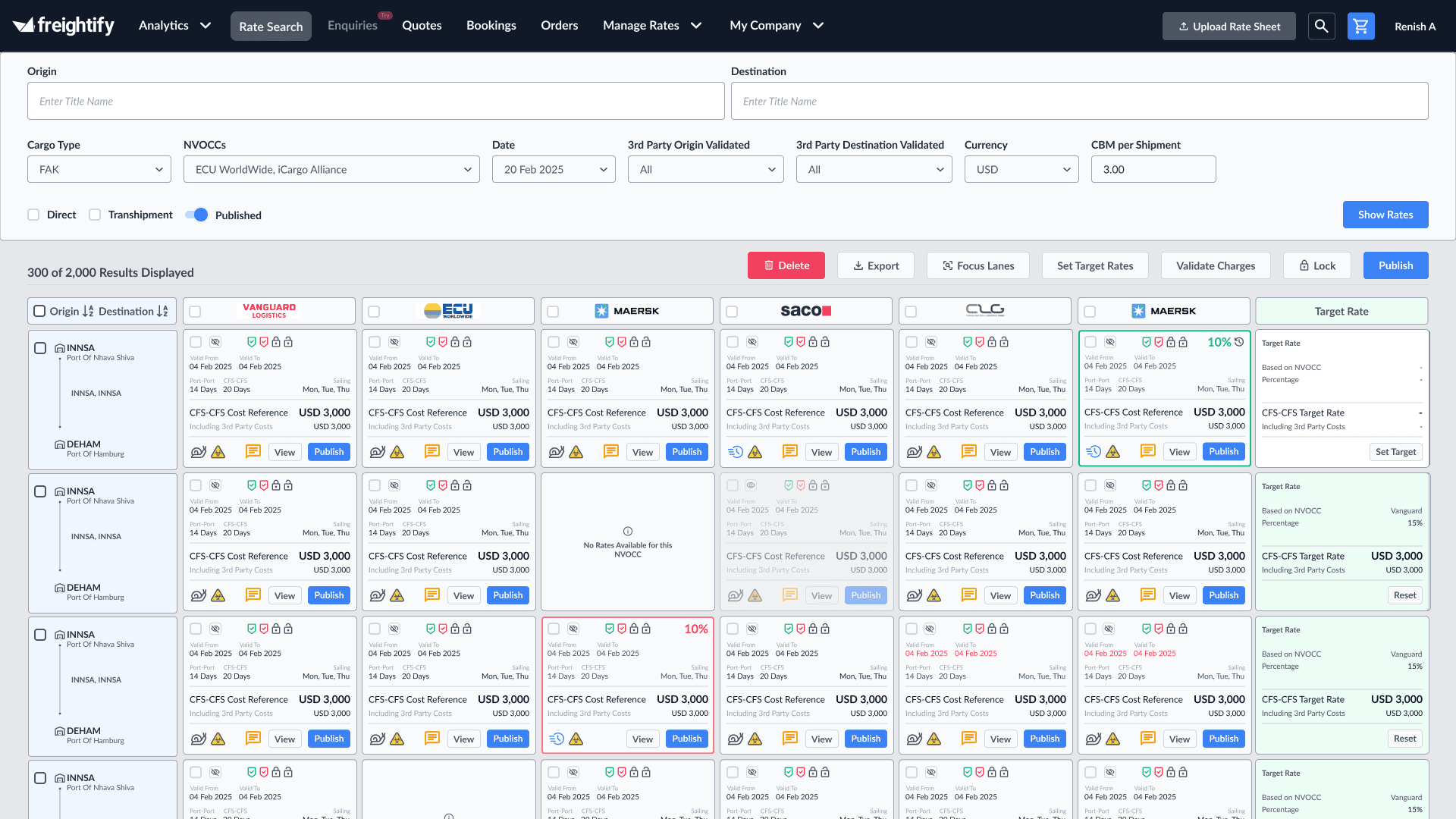
Your LCL Operation Has a Revenue Leak. Most Forwarders Never Find It.
Freight forwarders in the US and Europe lose LCL quotes daily — not from bad rates, but broken pricing workflows. See how the right LCL pricing software fixes this.
Wisor vs Freightify: Which Rate Management Platform Should You Choose? [2026]
Data-driven comparison based on 88 reviews. Implementation speed, multi-office capabilities, accuracy guarantees. 5-minute read.