News
Explore how AI in logistics and supply chain streamlines operations, predicts disruptions, and drives efficiency for freight forwarders.

Team Freightify
AI in supply chain operations enables faster decision-making, real-time visibility, and cost savings across logistics networks.
Predictive analytics helps freight forwarders forecast demand, avoid disruptions, and optimize planning.
AI automates critical functions like carrier matching, contract management, and inventory tracking, boosting overall efficiency.
Legacy systems, data quality issues, and a lack of AI-skilled talent remain key barriers to full-scale implementation.
A shipment delay in Shanghai causes missed deadlines in the US Midwest, and fuel prices surge, causing the cost of shipping to spike overnight. Artificial intelligence (AI) can streamline these issues and make supply chains more robust. That's why the use of AI in supply chain operations is gaining ground fast, with the global "AI in logistics" market forecasted to reach $707 billion by 2034.
Businesses are already turning en masse to AI for supply management to predict disruptions, automate tasks, and act faster. 36% of businesses have already implemented AI in logistics, with another 28% of companies in the process of implementing AI. Let's explore how AI transforms the logistics industry and impacts freight forwarders.
AI models are trained on historical datasets to identify patterns and make predictions of likely outcomes. This intelligence can be invaluable to freight forwarders to:
Predict customer demand with high accuracy
Forecast supplier delays and raw material shortages
Use historical and real-time data for dynamic planning
Minimize inventory risk and delivery failures
An AI supply chain can adapt quickly to global changes, keeping operations steady in unpredictable conditions.
How AI Creates Competitive Advantage in Freight and Supply Management
AI in logistics and supply chain systems boosts efficiency by enabling businesses to:
Automate order tracking
Analyze demand requirements for load optimization (on average, a truck in the US runs at 30% empty, and AI can optimize this by almost 50%).
Make warehouse operations more efficient.
In an era when AI is taking over every business function, it can be easy to understate the impact it can unlock in AI for supply chain management. Imagine your business delivering more with fewer resources, providing better results at lower costs.
The Future of AI in Supply Chains & Freight-Forwarding
The next wave of AI supply chain innovation is already in full swing, introducing next-generation automation and intelligence to each point in the logistics chain.
Fully autonomous vehicles: Driverless lorries and drones eliminate labor dependency and optimize delivery speed.
Enhanced customs clearance: AI streamlines document verification, tariff codes, and approvals, reducing delays in cross-border operations.
Smart warehousing: AI-powered robotics pick, pack, and sort products, minimizing mistakes and optimizing inventory visibility.
Blockchain integration: AI employs blockchain to trace products securely. All transactions are maintained in a unique ledger, enhancing trust and traceability.
How AI in Freight-Forwarding Improves Operations
AI in freight forwarding is transforming day-to-day operations by boosting speed, accuracy, and decision-making across the board:
Automating compliance and document processing: AI scans and validates documents instantly. This eliminates manual data entry and filing errors, speeding up customs, billing, and regulatory paperwork.
Optimizing route planning and shipment management: AI uses real-time GPS, traffic, and weather data to help select the most efficient and cost-effective routes, reducing delivery times and fuel consumption.
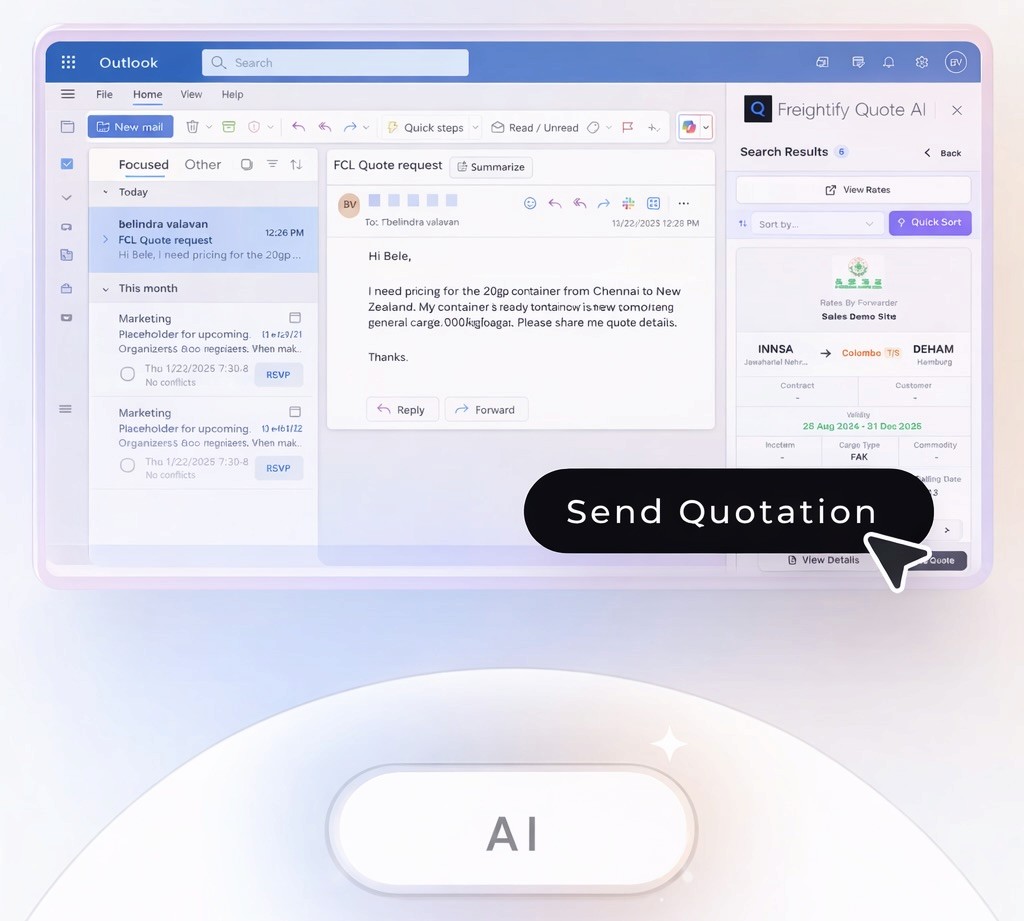
Enhancing freight quotes: Advanced analytics can swiftly study carrier pricing to produce instant, competitive, and accurate freight quotes. This helps businesses overcome volatile market conditions, limited transparency, complex contract negotiations, and capacity constraints.
Enhancing inventory management: AI-powered inventory management tools track real-time stock levels across warehouses. They forecast restock timing and inventory turnover, reducing overstock and out-of-stock situations.
Automating carrier matching: Automated matching systems instantly match freight with best-fit carriers, considering cost, service history, and availability. The outcome is improved load utilization and delivery speed.
Faster carrier contract management: AI automates contract creation and updates, streamlining vendor negotiations. Businesses that use automated contract management systems report an 80% faster cycle time from bid to agreement.
Improving risk management: A 2024 study revealed that supply chains will face increased weather-induced disruptions over the next 15 years. AI models process vast amounts of data and monitor weather and geopolitical changes. They can flag risks to routes, ports, or suppliers, helping businesses avoid costly disruptions.
Enhancing customer experience: Studies show that 81% of customers expect brands to provide personalized service. AI chatbots offer real-time support and shipment tracking, which reduces inquiry volumes and boosts customer satisfaction.
Challenges of Implementing AI in Supply Chains and Logistics
Data requirements: AI needs accurate, structured data to work well, a dataops challenge for many legacy freight forwarders.
Data security: A 2024 IBM cybersecurity report states that a single data breach costs $4.88 million. Strong cybersecurity frameworks must protect sensitive supply chain data.
Integration of AI with existing systems: Legacy systems may not support AI plugins, requiring major upgrades or middleware. Additionally, AI solutions are not yet "human," studies show that 53% of customers still prefer engaging with a human agent.
Skill development: AI systems demand new skills in data science and analytics. However, a global study revealed that 75% of organizations struggle to hire AI-skilled resources.
Regulation: Companies should make AI systems easy to explain, unbiased and with strong data privacy fundamentals to avoid penalties.
Perhaps decision-makers should acquaint themselves with a larger digital transformation vision to implement new technology using the right approach.
Leverage the Potential of AI in Freight-Forwarding
AI in logistics is the new standard for successful freight forwarders. To unlock its full value, businesses must:
Clean and standardize supply chain data
Invest in flexible platforms with AI capabilities
Make their workforce digitally / data literate
Stay current on procurement and supply chain news
AI technology was introduced into logistics just a decade ago and already looks primitive today. A practical way to understand the potential of AI is to imagine a future of the freight industry minus the heavy lifting of manually providing quotations, accepting email/telephonic bookings, managing documentation, and coordinating and tracking shipments. As 'travel agents' of global trade, freight forwarders must harness the power of AI to catapult the industry forward.
FAQs
1. How is AI transforming the role of freight forwarders?
AI is automating many time-consuming tasks like documentation, route planning, quoting, and shipment tracking. This allows freight forwarders to shift their focus from transactional tasks to value-added services. As a result, they operate more efficiently and offer a better customer experience.
2. What challenges do logistics companies face when adopting AI?
Common hurdles include poor data quality, outdated legacy systems, and a shortage of skilled AI professionals. Integration can also be difficult if the business lacks a broader digital transformation strategy. Additionally, concerns around data privacy and explainable AI are growing due to evolving regulations.
3. How does AI improve risk management in supply chains?
AI systems process vast amounts of data from weather reports, political news, and supply chain patterns. They flag potential risks early—like storms, strikes, or port closures—allowing businesses to act proactively. This predictive visibility reduces delays and protects against costly disruptions.
The Traditional Bottleneck | The Empowered Reality |
|---|---|
Procurement/Sales as Data Administrator | Procurement/Sales as Strategic Contributor |
Decisions driven by intuition and outdated spreadsheets | Decisions informed by real-time rate benchmarks and eco-friendly rate decisions |
Rates siloed, creating quote latency and risk | Unified Rate Engine allows instantaneous, accurate global quoting |
Reliance on manual data entry leading to inevitable margin leakage | Maximized margin retention through precise, governed data |
Frequently Asked Questions
Q: What is data-driven decision-making in freight forwarding?
It’s the process of using centralized, structured data and AI insights to drive procurement, pricing, and quoting decisions across global teams.
Q: Why is it difficult for freight forwarders to become data-driven?
Because most use legacy TMS systems and Excel workarounds that trap information in silos, making collaboration and transparency difficult.
Q: What is decision intelligence in logistics?
Decision intelligence connects data, people, and AI systems to continuously learn from transactions—transforming experience into scalable foresight.
Q: How does AI improve freight pricing and procurement?
AI learns from historical contracts, quotes, and bookings to suggest optimal pricing, detect anomalies, and improve margin consistency.
Stay updated with Freightify
Subscribe to our blog for the latest updates and insights delivered to your inbox.
Suggested Stories
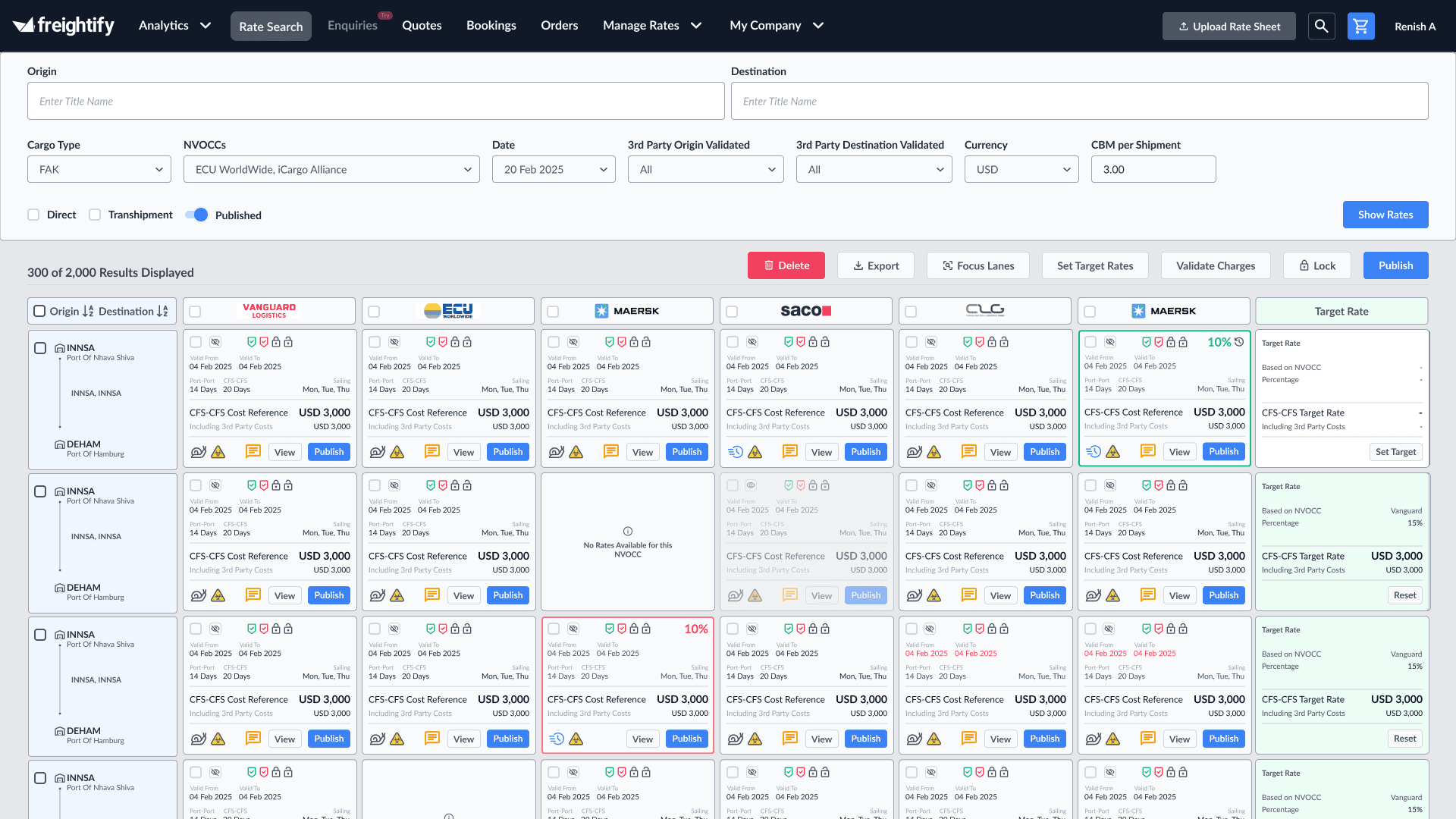
Your LCL Operation Has a Revenue Leak. Most Forwarders Never Find It.
Freight forwarders in the US and Europe lose LCL quotes daily — not from bad rates, but broken pricing workflows. See how the right LCL pricing software fixes this.
Wisor vs Freightify: Which Rate Management Platform Should You Choose? [2026]
Data-driven comparison based on 88 reviews. Implementation speed, multi-office capabilities, accuracy guarantees. 5-minute read.