
News
Discover how Trump’s 2025 tariffs, climate events, and global trade shifts will reshape ocean freight routes, costs, and supply chains. Get key predictions and strategies to stay ahead.

Team Freightify
Trump’s imposed tariffs will reshape freight ocean routes and volumes from China and the rest of the world.
Geopolitical shifts and climate change will cause disruptions, increasing freight costs and transit time.
Freight companies quickly adopt index-driven contracts and digitize freight platforms for efficient supply chains.
Expect a shift in preferred trade lanes from traditional Asia-US to nearshoring in Latin America and Southeast Asia
The global ocean freight market has had to undergo several recalibrations post-COVID. 2025 is especially crucial as the market adjusts to changing geopolitical relations and trade policies. Into his second term as President, Trump has announced a universal 10% tariff rate for all trade partners except China, whose tariff rates now stand at 145%. This will cause significant global turbulence in the ocean freight market.
The transportation sector will face a considerable slump, including freight carriers facing an overall 15% cargo decline. Everyday bookings for cargo containers from China to the US have already slumped by 25%. The Ocean freight market is sensitive to geopolitical decisions and economic sentiments across the globe.
Proposed Tariffs and Their Economic Impacts
What happened during Trump’s first term?
The Trump 1.0 administration (2016-2020) levied tariffs of $50 billion on Chinese goods. This heavily impacted the ocean freight market, and freight companies globally had to shift sharply to their ocean routes and strategies to manage demand.
What’s happening in the second term?
The new 2025 tariffs announced by Trump relate to his reigniting the ‘America First’ policy, which is especially targeting China, Mexico, and the European Union. As of 30th April, 2025, the Trump administration has levied a 145% tariff on Chinese goods except for smartphones, automatic data processing machines, and certain electronic components, including diodes, transistors and thyristors. China has imposed a 125% tariff on American goods (except for certain exemptions like pharmaceuticals, aircraft engines and microchips) in retaliation.
While tariffs on all other countries are paused for 90 days with a blanket 10% on all imports, this will undoubtedly result in lower import volumes into the US, which will result in higher costs for American businesses and consumers. Ocean freight companies will now have lower eastbound trans-Pacific volumes, which also means they will potentially surge in nearshoring-related lanes like Latin America.
Top Five Predictions You Need to Know!
With Trump’s tariff announcements, the freight industry will be faced with new political and economic upheaval. In this scenario, many freight trends are emerging that carriers and shippers must consider while making structural adaptations.
1. Supply and Demand Dynamics Continue to Evolve in 2025
Ocean freight is constantly transforming. Currently, demand is uncertain as the global economy is overly cautious. The only way freight companies can ease the pressure is by adding capacity. We will see lower volumes on trade lanes between the US and China. Demand will be redirected to lanes within Asia and the North-South.
2. Ongoing Disruptions Add Uncertainty and Longer Transit Time
While climate-driven disruptions have always been a reliability factor, geopolitical instability is ever-increasing. Congestion at ports is something freight companies will have to deal with regularly. In November 2024, the Red Sea region faced Houthi attacks, disrupting transport. It led to many freight carriers rerouting through the Cape of Good Hope, which has added 10-14 days to their transit time. A disruption in one region creates a domino effect in the freight industry, inflates global costs and impacts the entire supply chain, especially in the case of time-sensitive goods.
3. New Shipping Alliances Bring Major Tactical Challenges
Due to disruptions, many freight companies must forge new relationships with shippers and vessel owners worldwide. This breaking of traditional alliances results in slower progress as freight companies must adapt to the shuffling of vessels and service reliability. The recent tariff changes will push freight companies to fragment capacity management, increasing risks.
4. Index-Linked Deals and Enforceable Contracts Become More Popular
Index-linked contracts like those with SCFI or FBX offer relief from volatility. They do this by making their contracts flexible and transparent. Freight companies prefer to rely on these for volatile markets.
5. Regulations and Tariffs Mean Shifts in Trade Patterns
Although there is a 90-day pause on the tariffs announced by Trump, the changes in US tariffs will result in many freight companies rerouting trade flows away from China. This will open new freight industry markets, reshaping capacity allocation and procurement. More such trade regulations will shift trade patterns across the globe.
Freight Demand Projections
Although the demand outlook for 2025 has been volatile due to factors such as the uncertainty around tariffs, once these tariffs are in place, US import demand will decrease drastically. However, analysts are also expecting increased demand, especially in Asia and Latin America, with new sourcing hubs like Vietnam, India, and Mexico.
Supply is also expected to increase, with a consequent increase in vessel capacity. Around 2 million TEUs of new vessel capacity are expected to be added in 2025. This will affect freight rates globally. However, once the secondary trade lanes are fully established, the increase in demand may help stabilize freight rates.
Navigating the New Era of Freight
In 2025, the pace at which freight companies can adapt to newer strategies will be critical. Two of those strategies are diversifying trade routes and digitizing the supply chain. Index-driven contract transparency and real-time supply chain tracking are essential for freight forwarding companies. Freight businesses must stay agile with dual sourcing and inventory buffering. Investing in these strategies will help mitigate risk amid trade volatility.
Final Word
Due to Trump’s tariff announcements in 2025, some reshuffling of trade partnerships and overall volatility are expected. Ocean freight companies should navigate new avenues arising out of changing political winds and increasing consumer demands. If the pandemic taught us anything, it is that adversity breeds resilience and transformation.
FAQs
How will Trump’s proposed tariffs impact shipping costs in 2025?
Shipping costs and customs duties are expected to increase because of reduced volumes with supply chain changes.
Which trade routes are expected to gain importance in 2025?
Due to the expected volume reduction between the US and China, trade lanes between the US and Southeast Asia, namely India, Vietnam and Latin America, are expected to gain importance.
What strategies can businesses adopt to handle ocean freight volatility?
Index-linked contracts and real-time supply chain tracking are two main strategies that ocean freight companies must adopt. The former will ensure transparency, and the latter will help with predictive insights, further helping build a resilient supply chain.
Frequently Asked Questions
Q: What is data-driven decision-making in freight forwarding?
It’s the process of using centralized, structured data and AI insights to drive procurement, pricing, and quoting decisions across global teams.
Q: Why is it difficult for freight forwarders to become data-driven?
Because most use legacy TMS systems and Excel workarounds that trap information in silos, making collaboration and transparency difficult.
Q: What is decision intelligence in logistics?
Decision intelligence connects data, people, and AI systems to continuously learn from transactions—transforming experience into scalable foresight.
Q: How does AI improve freight pricing and procurement?
AI learns from historical contracts, quotes, and bookings to suggest optimal pricing, detect anomalies, and improve margin consistency.
Stay updated with Freightify
Subscribe to our blog for the latest updates and insights delivered to your inbox.
Suggested Stories
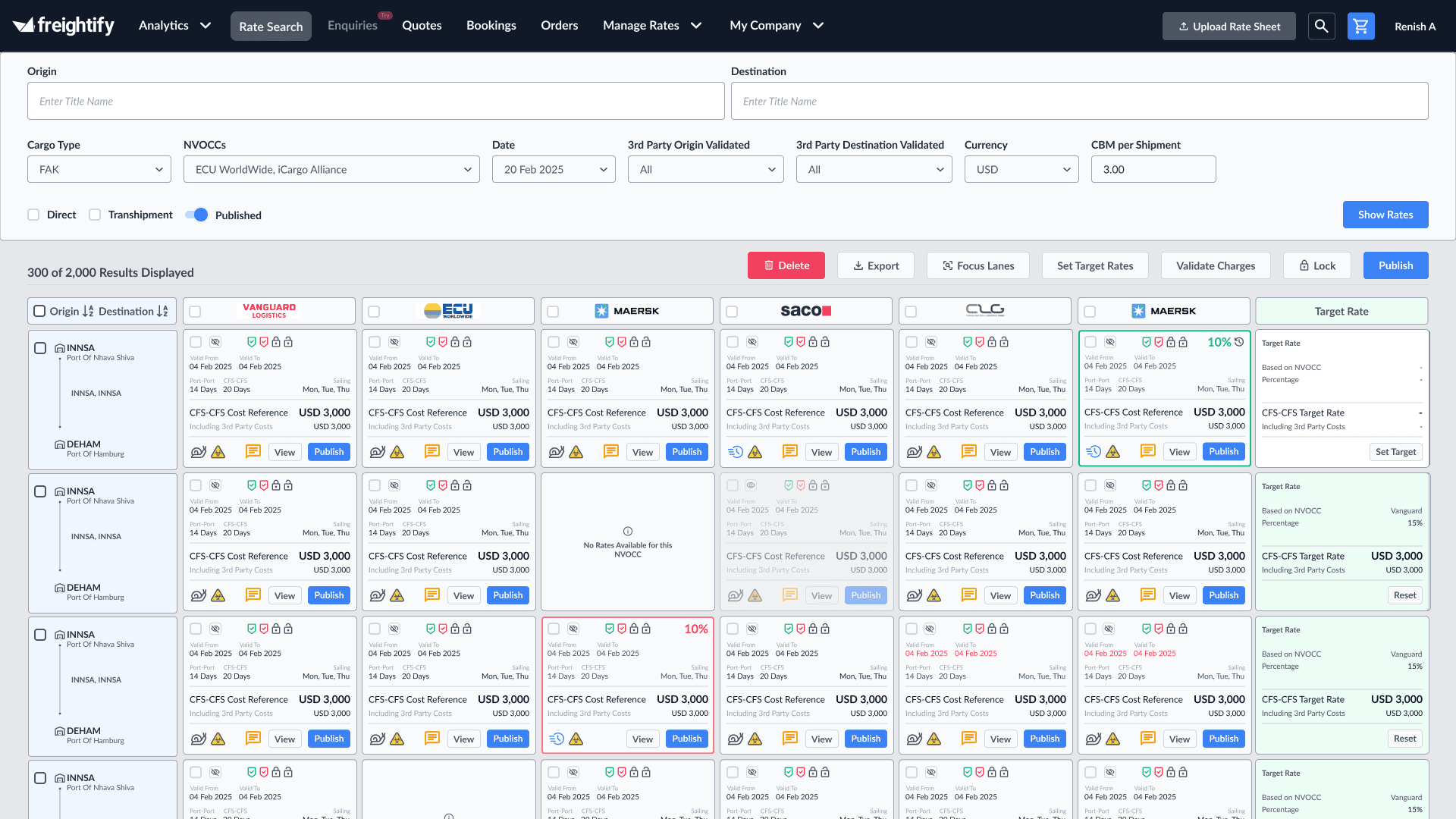
Your LCL Operation Has a Revenue Leak. Most Forwarders Never Find It.
Freight forwarders in the US and Europe lose LCL quotes daily — not from bad rates, but broken pricing workflows. See how the right LCL pricing software fixes this.
Wisor vs Freightify: Which Rate Management Platform Should You Choose? [2026]
Data-driven comparison based on 88 reviews. Implementation speed, multi-office capabilities, accuracy guarantees. 5-minute read.