
News
Explore the latest US trade war in 2025 & its impact on the freight industry. Stay ahead with actionable insights for a dynamic global trade landscape.

Team Freightify
Recent trade policy changes announced by the Trump administration mark a significant turning point in US international trade relations. According to the U.S. Census Bureau's latest trade report, these changes, effective February 4th, 2025, bring substantial implications for freight forwarders, shippers, and supply chain managers across North America.
North American Trade Relations Transformed
One of the most notable changes is the shift in trade dynamics between the U.S., Canada, and Mexico, moving away from the USMCA's free trade framework. The introduction of a 25% blanket tariff on Canadian and Mexican imports marks a significant disruption to trade patterns, with Canada alone accounting for $776.9 billion in trade in 2023. These tariffs are set to have far-reaching consequences for one of the world's largest trading relationships, though their implementation has been postponed by a month.
While energy imports from Canada face a lower 10% tariff, this still marks a dramatic change from the previous tariff-free structure. According to the U.S. Energy Information Administration, Canadian energy exports to the U.S., including oil, natural gas, and electricity, accounted for over $150 billion in trade value last year².
China Trade Relations: Adding to Existing Complexity
The addition of a 10% tariff on Chinese imports, layered on top of existing Section 301 tariffs, creates a complex situation where some goods may face combined tariffs of up to 35%. The Peterson Institute for International Economics reports that these increased tariffs now impact over $300 billion worth of goods.
For freight operations, this means:
Increased documentation requirements
More complex duty calculations
Potential shifts in shipping patterns as importers seek alternative sources
De Minimis Changes: Impact on E-commerce Logistics
The suspension of the $800 de minimis exemption for products subject to these new tariffs significantly impacts e-commerce logistics. According to U.S. Customs and Border Protection⁴, this change affects millions of small-value shipments annually, particularly impacting:
Small parcel shipments from affected countries
E-commerce fulfillment operations
Cross-border shipping strategies
Duty Drawback Elimination: Financial Implications
The elimination of duty drawbacks under these new tariffs presents additional financial challenges for businesses involved in re-export operations. This change means:
No recovery of duties on re-exported goods
Increased costs for manufacturing operations using imported components
Need for revised pricing strategies in international trade
Looking Ahead: Industry Adaptation
As a freight technology company, we recognize these changes require rapid adaptation in how we serve our clients. Our software platforms are being updated to reflect these new tariff structures and documentation requirements, ensuring our users can navigate these changes effectively.
Key considerations for freight professionals:
Review all existing shipping contracts and rates
Update customs documentation procedures
Communicate changes proactively to clients
Monitor for potential supply chain restructuring
Navigate Complex Trade Policies with Freightify
In times of complex trade policy shifts, having the right technology partner becomes more crucial than ever. Freightify's advanced freight rate management system is specifically designed to help you:
Automatically calculate and update tariffs across multiple trade lanes
Streamline customs documentation processes
Track and manage changing regulatory requirements
Provide instant, accurate quotes that account for new tariff structures
Ready to Transform Your Freight Operations?
🔍 Schedule a Demo Today
Discover how our platform can help you:
Automate tariff calculations
Simplify compliance processes
Optimize shipping routes under new regulations
Maintain profitability despite policy changes
Want to learn more? Our expert team is ready to show you how Freightify can help your business thrive in this evolving trade environment. See Freightify in action—book your demo today!
Frequently Asked Questions:
1. How do the new tariffs differ from previous ones?
The new tariffs announced by the Trump administration mark a notable escalation in U.S. trade policy. These tariffs are broader in scope, imposing a 25% duty on all imports from Mexico and Canada, except for Canadian energy products, which are subject to a 10% tariff. Additionally, a 10% tariff has been applied to a wide range of Chinese imports. These measures are aimed at tackling perceived issues such as unfair trade practices, intellectual property theft, and trade imbalances.
2.What potential outcomes can we anticipate?
These tariffs are likely to dampen U.S. economic growth unless swift trade negotiations among the involved trading partners lead to their reversal. While trade may not constitute a large portion of U.S. nominal GDP, it significantly affects intermediate prices, labor costs, and the revenues of domestic producers.
If the tariffs remain in place, the anticipated consequences include slower economic growth for the U.S. and its trade partners, job losses, and higher costs for consumers. The agriculture, automotive, and energy sectors are expected to experience the most significant impacts.
Frequently Asked Questions
Q: What is data-driven decision-making in freight forwarding?
It’s the process of using centralized, structured data and AI insights to drive procurement, pricing, and quoting decisions across global teams.
Q: Why is it difficult for freight forwarders to become data-driven?
Because most use legacy TMS systems and Excel workarounds that trap information in silos, making collaboration and transparency difficult.
Q: What is decision intelligence in logistics?
Decision intelligence connects data, people, and AI systems to continuously learn from transactions—transforming experience into scalable foresight.
Q: How does AI improve freight pricing and procurement?
AI learns from historical contracts, quotes, and bookings to suggest optimal pricing, detect anomalies, and improve margin consistency.
Stay updated with Freightify
Subscribe to our blog for the latest updates and insights delivered to your inbox.
Suggested Stories
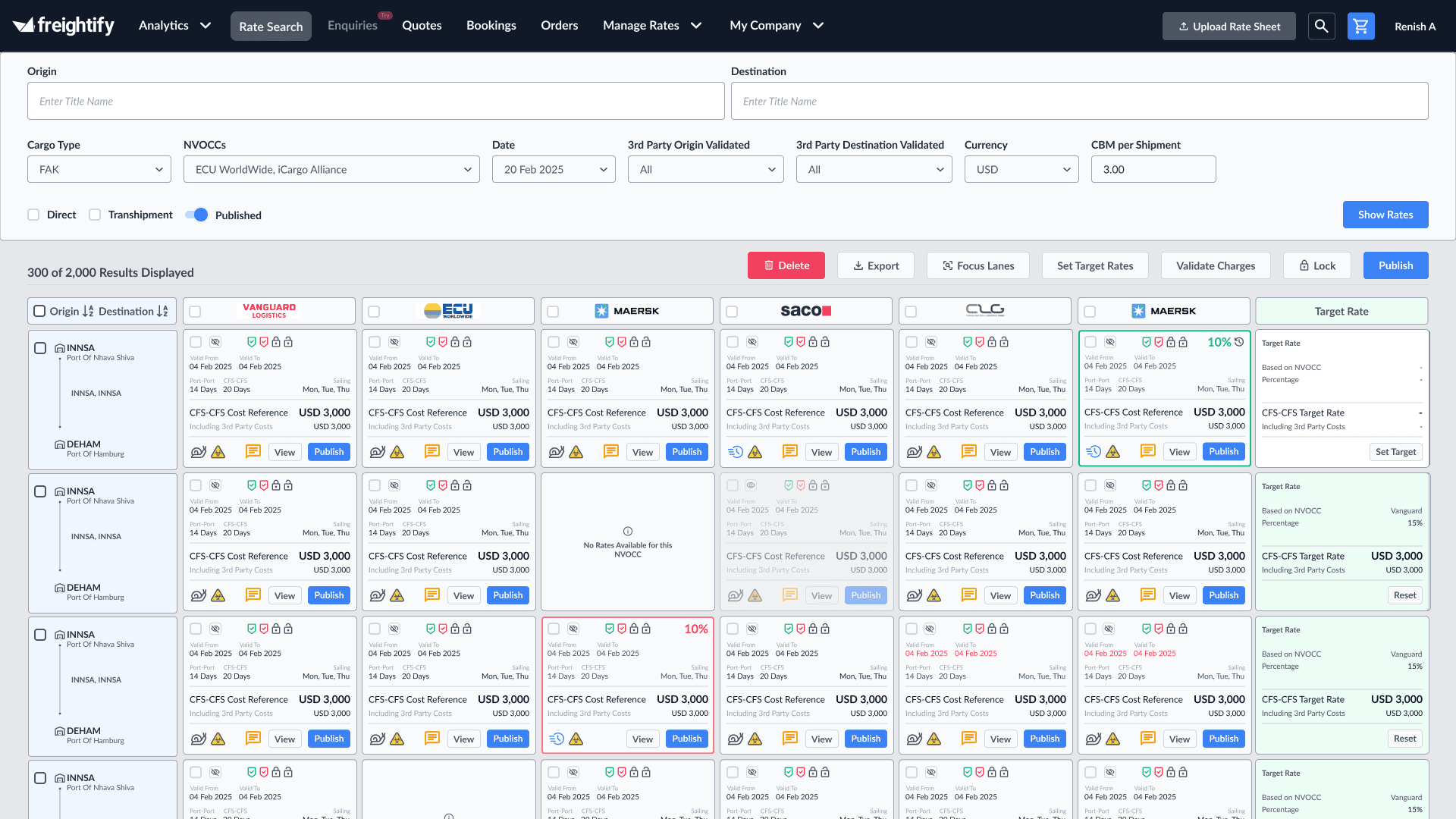
Your LCL Operation Has a Revenue Leak. Most Forwarders Never Find It.
Freight forwarders in the US and Europe lose LCL quotes daily — not from bad rates, but broken pricing workflows. See how the right LCL pricing software fixes this.
Wisor vs Freightify: Which Rate Management Platform Should You Choose? [2026]
Data-driven comparison based on 88 reviews. Implementation speed, multi-office capabilities, accuracy guarantees. 5-minute read.